COMPLAPSE
Improving the precision of behaviour change theories: a dynamic computational model of lapse risk in smokers attempting to stop
COMPLAPSE developed and validated a formal and computational model of smoking lapse and relapse. The project combined scientific theory, patient perspectives and clinical know-how. The model is available as an interactive web app and can be used to simulate relapse risk and to inform personalised, evidence-based digital cessation strategies.
Explore the model (web app) Code on GitHub Read the paper

Logo designed using image by bsd_studio (Image #28812502 at VectorStock.com).
Project video
Discover how COMPLAPSE is turning complexity into actionable insights for public health. Video produced by Booster.
Aims and objectives
Cigarette smoking remains the leading preventable cause of premature morbidity and mortality in Europe and beyond. Gold standard treatment for smoking cessation includes pharmacotherapy and behavioural support. However, smoking lapses, which are influenced by momentary fluctuations in cigarette availability, stress and cravings, are a key source of treatment failure.
COMPLAPSE aims to advance the state of the art by developing and validating a formal, dynamical systems model of lapse risk. This improves the precision of static behaviour change theories, so that they can account for observed complexities, and lays the foundation for dynamically tailored, person-centred digital smoking cessation interventions with greater effectiveness. The project is interdisciplinary, drawing on know-how from behavioural science and from systems science and dynamical systems modelling. It directly contributes to Europe’s Path to the Digital Decade and its Strategic Framework for the Prevention of Non-Communicable Diseases.
COMPLAPSE addresses three Research and Innovation Objectives (ROIs), each associated with a dedicated work package (WP):
- ROI1. To develop a conceptual model of lapse risk, drawing on stakeholder input and the researchers’ knowledge of the available literature via participatory systems mapping (WP1).
- ROI2. To formulate mathematical equations for each component in the conceptual model and conduct a series of computer simulations (WP2).
- ROI3. To collect and analyse EMA and sensor data and use these to validate the expert-derived dynamic computational model (WP3).
WP1: A conceptual model of lapse risk
Theories are needed to predict, explain and influence phenomena of interest. Popular relapse prevention theories are vaguely specified using natural language descriptions and lack temporal information about how key phenomena (i.e., ‘relapse’, ‘prolapse’, ‘abstinence’) are dynamically caused over time and within individuals. Formal modelling translates a theory’s structure into a mathematical framework and can help mitigate the ongoing ‘theory crisis’ in psychology and related disciplines, which contributes to the wider reproducibility crisis.
Read more: Towards improving the precision of health psychology theories.
The aim of WP1 was to develop a conceptual model of lapse risk in smokers attempting to stop, with a view to using it to formulate a formal and computational model. Because fit-for-purpose methodological guidance was lacking, we first conducted a scoping review of research using formal and computational modelling to predict, explain and influence health behaviours that unfold at the within-person level. We synthesised the methodological steps in the published literature and generated a set of initial, expert-derived ‘best practice’ modelling recommendations.
Formal and computational modelling has been used for decades in other scientific disciplines, so we also took a broader perspective and conducted a second scoping review that synthesised modelling guidance from diverse disciplines (e.g., psychology, engineering, biology, physics). The two scoping reviews, and ongoing discussions with the interdisciplinary researchers involved, informed the next steps of the research.
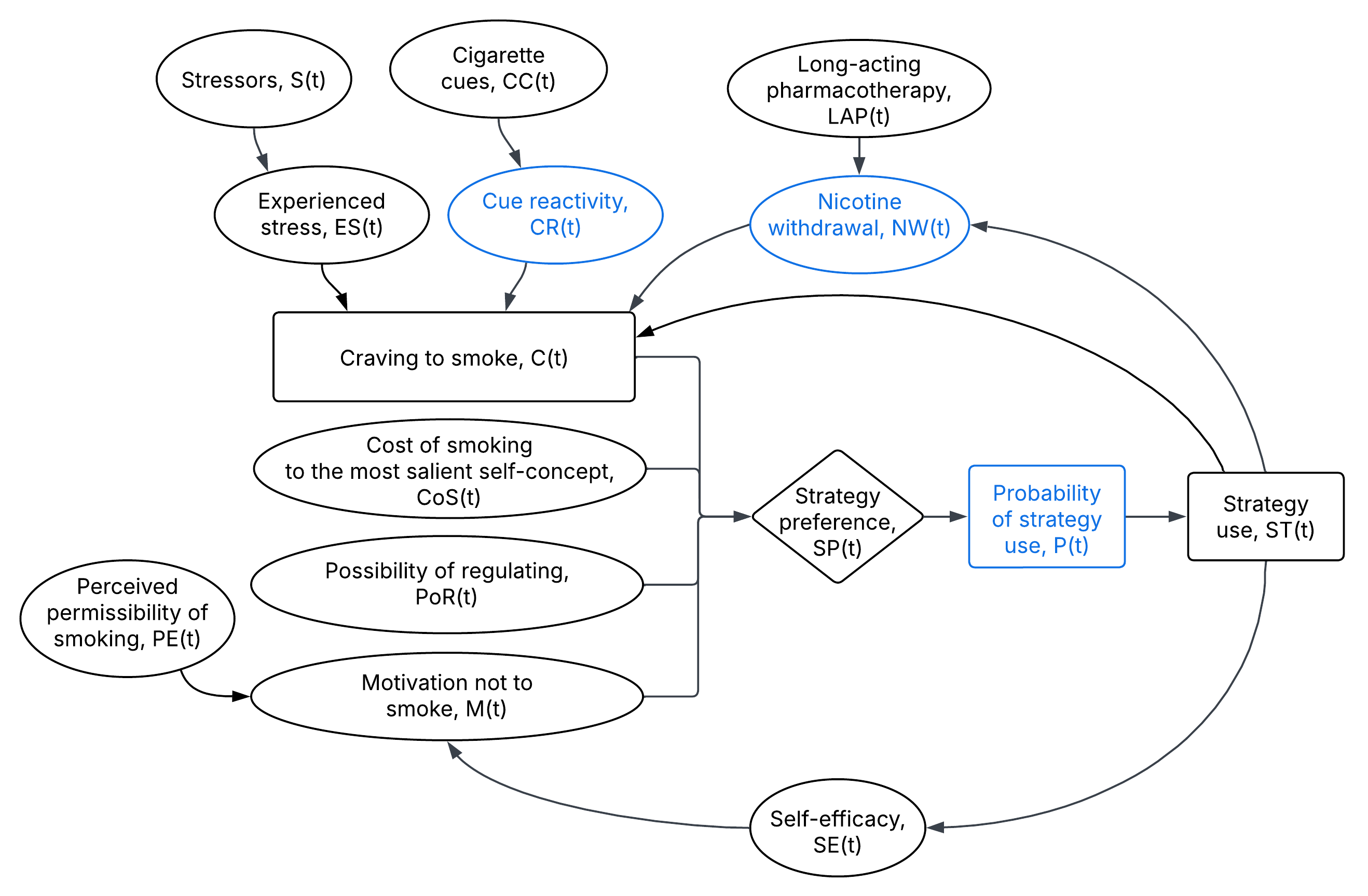
We then drew on Theory Construction Methodology to develop a dynamic model of smoking lapse and relapse. A participatory, multi-method approach was used to iteratively develop the conceptual model (also referred to as a ‘prototheory’), comprising (i) an informal review of popular lapse and relapse theories and (ii) two linked stakeholder interviews with researchers, people with lived experience, stop smoking practitioners and policymakers (N = 15).
WP2: A formal and computational model
We translated the prototheory into a series of difference equations, implemented in R code and an R Shiny application that lets anyone explore the dynamic model. A series of computer simulations examined whether the model could reproduce the empirical phenomena it set out to explain (i.e., ‘relapse’, ‘prolapse’, ‘abstinence’). Stakeholders were invited back to give feedback on the simulated model outputs, and their feedback was incorporated into an updated version of the model.
The paper describing the development and initial evaluation of the model, “Using Formal and Computational Modelling to Develop an Initial Within-Person System Dynamics Model of Relapse in Smoking Cessation: A Participatory, Iterative, Multi-Method Approach”, has been peer reviewed and recommended by Peer Community In Psychology. The preprint is also freely available. Read more: The participatory development of a formal and computational model of smoking lapse and relapse.
We also wrote a magazine article on how health psychology and mathematics/modelling know-how were integrated to translate the prototheory into a formal and computational model: Formal, dynamical systems modelling to advance health psychology theories: Interdisciplinary working where psychology meets mathematics.
WP3: Empirical evaluation
In the final stage of COMPLAPSE, pilot EMA and smartwatch data were collected to empirically evaluate the dynamic model of lapse and relapse. Pilot data collection is now complete. We will fit the formal model to the data from each participant and calculate goodness-of-fit statistics.
Funding
COMPLAPSE was funded between 2022 and 2025 by the European Commission under the Horizon Europe Framework Programme (HORIZON), Grant No. 101065293 (PI: Dr Olga Perski; mentors: Prof. Nelli Hankonen and Prof. Eric Hekler).